Coarse Sand
2–0.5 mm
≤1.5 t/h published
Use the model table for the selected deck; actual duty requires representative feed testing
Gravity Separation
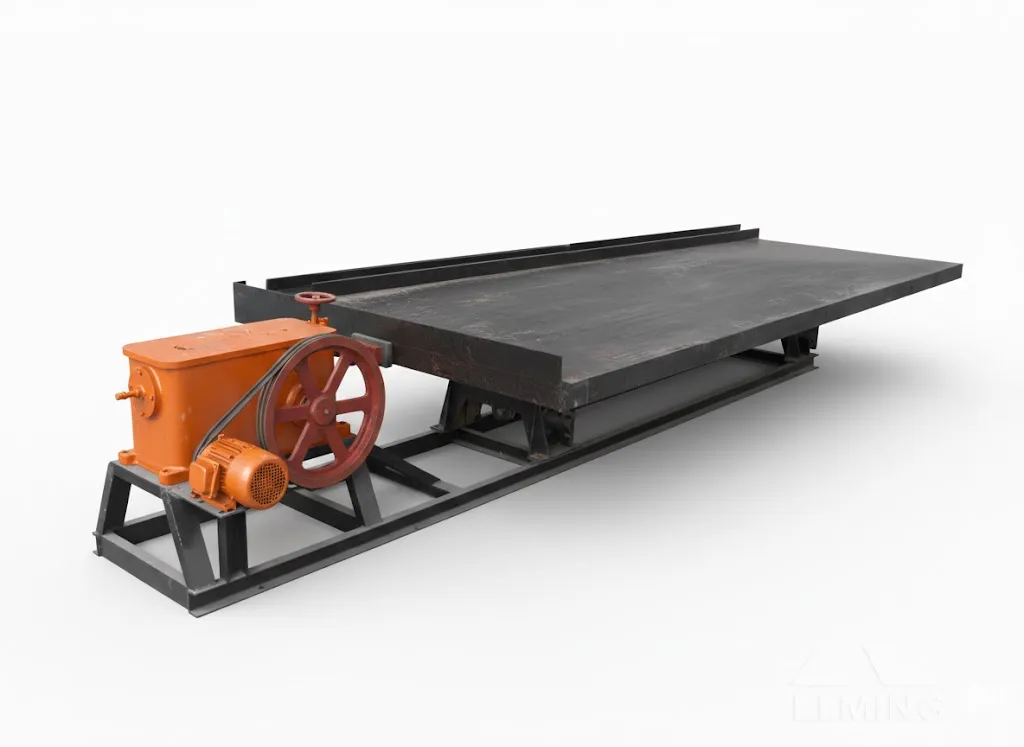
A gravity-separation table for evaluating liberated gold, tungsten, tin, tantalum, and chromite across published deck feed ranges. The table itself uses water and deck motion for physical separation; recovery and any downstream treatment require representative testwork.
Pricing
We quote per project rather than publishing a single figure, because the same machine name covers models an order of magnitude apart in price. Send your duty and you get a real number back, not a brochure.
Deck count and table size
Throughput per deck is small, so the quote is driven by how many decks your tonnage needs rather than by one table.
Deck covering and riffle pattern
The covering material and riffle layout are matched to your target mineral and size fraction, and both change the price.
Frame and drive mechanism
The head motion, motor rating and frame construction are separate line items from the deck.
Feed preparation scope
Tables need a controlled, classified feed. Distributors, feed boxes and launders are quoted outside the table itself.
Send the material, your required t/h and the destination port. That is enough for a quote — you do not need a full specification first.
Get Price on WhatsAppTypical reply within 12 hours · English and Chinese
A shaking table separates particles through the combined effects of density, size, shape, liberation, wash water, and asymmetric deck motion. The table is a physical separation stage; the wider plant may still require downstream treatment selected from representative testwork.
01
The drive unit creates a slow forward stroke and fast return stroke. Heavy particles are carried updip by inertia on the forward stroke; lighter particles are left behind on the fast return.
02
Wash water flows across the deck from the launder side toward the tailings side. Lighter, smaller particles are swept sideways faster; heavy particles resist the water and travel further up the deck.
03
The combined action stratifies particles into a fan: high-SG concentrate at the top, middlings in the middle, and tailings at the bottom. Splitters divide each zone for separate collection.
What the table itself does
Inside the table, separation uses density, particle size and shape, liberation, water, and deck motion. That physical duty does not define the wider plant: flotation, leaching, concentrate treatment, water management, and disposal controls still depend on mineralogy and testwork.
4 models including a dedicated slime deck (LS-4500) for sub-74 μm feed.
| Model | Deck Size | Max Feed Size | Capacity | Motor Power | Weight | Get Quote |
|---|---|---|---|---|---|---|
| 6-S (1100) | 1100×500 mm | 2 mm | 0.1–0.5 t/h | 0.55 kW | 0.15 t | Quote |
| 6-S (2100) | 2100×900 mm | 2 mm | 0.1–0.8 t/h | 0.75 kW | 0.3 t | Quote |
| 6-S (4500) | 4500×1850 mm | 2 mm | 0.2–1.5 t/h | 1.1 kW | 0.48 t | Quote |
| LS-4500 (Slime) | 4500×1850 mm | 0.5 mm | 0.15–1.0 t/h | 1.1 kW | 0.48 t | Quote |
Coarse Sand
2–0.5 mm
≤1.5 t/h published
Use the model table for the selected deck; actual duty requires representative feed testing
Fine Sand
0.5–0.074 mm
0.3–1.2 t/h
Fine-grained gold, fine cassiterite, tantalum-niobium
Ore Slime
< 0.074 mm
0.1–0.6 t/h
The LS-4500 slime deck is listed for sub-74 μm feed; recovery and suitability must be confirmed by representative mineral testwork
* Capacity per single table unit. Run multiple tables in parallel to scale throughput.
The 6-S table can be evaluated as a physical gravity stage for liberated free gold in alluvial or hard-rock circuits. Actual recovery and the lower effective particle size vary with liberation, size distribution, deck selection, stroke, and wash water, while any downstream chemical treatment belongs to the wider flowsheet and must be assessed separately.
Testwork
Recovery Rate
Confirm on representative liberated feed at the intended deck, stroke, and wash-water settings
<74 μm
Fine-Feed Duty
The LS-4500 slime deck is listed for fine feed; no universal lower recovery size should be assumed
0.3–0.6 t/h
Fine Gold Capacity
Per table on 0.074–0.5 mm gold feed; 0.15–0.3 t/h below 0.074 mm
Gravity stage
Separation Method
The table itself performs physical separation; any downstream flotation, leaching, concentrate treatment, or export specification depends on the selected flowsheet and testwork
Evaluate a table-led route when representative tests show a meaningful liberated free-gold fraction in a controllable size class.
Move sulfide-associated or poorly liberated gold to a testwork-defined flotation route instead of forcing gravity recovery.
For mixed ore domains, test early gravity recovery followed by flotation and define the operating trigger for switching modes.
If your gold is very fine or your grade is low, a shaking table alone can overload and lose values. Pairing a centrifugal concentrator (rougher) with the table (cleaner) can reduce table loading and may improve fine-gold recovery. Confirm the combined result with representative testwork before fixing the flowsheet.
Step 01
For ultra-fine or low-grade gold, run a centrifugal (Knelson-type) concentrator as the rougher. It captures fine free gold from large slurry volumes that a table alone would lose to overload.
Step 02
Feed the centrifuge concentrate to the 6-S table as a cleaning stage. The achievable concentrate grade, recovery, and suitability for downstream treatment must be confirmed on representative liberated feed.
Step 03
Return middlings for a second pass to evaluate whether overall recovery improves. A two-stage centrifuge and table circuit should be sized and recovery-tested on representative liberated feed.
Submit ore type, liberation data, particle-size distribution, and daily tonnage so the gravity flowsheet assumptions can be documented in the technical proposal.
Document Gravity InputsDensity contrast is only one input. Liberation, particle size and shape, deck selection, stroke, and wash water determine whether a mineral can be separated on a table.
Alluvial and hard-rock fine gold may be evaluated after liberation and size-distribution testing
Wolframite is a possible gravity-separation duty; concentrate grade and recovery require representative testwork
Fine cassiterite is a possible duty; lower effective size, grade, and recovery require representative testwork
Rare metal concentration; often combined with magnetic separation
Pre-concentration before smelting; removes gangue silicates efficiently
Fine hematite and magnetite slimes recovery; supplement to magnetic separation
Six key components — each adjustable during operation to optimise recovery and grade for your specific ore.
Fiberglass or rubber-lined deck with longitudinal riffles (grooves). Riffles trap heavy minerals while lighter particles are swept transversely by wash water. Spacing and height are optimised per feed size.
Eccentric or vibrating drive unit creates asymmetric reciprocating motion — a slow forward stroke and fast return. The resulting differential inertia moves heavy particles updip along the riffles.
Adjusts stroke amplitude (8–36 mm) while running. Longer stroke moves material faster and suits coarser feed; shorter stroke improves fine-particle separation.
Controls the deck's cross-slope (0–5°). Steeper slope increases water velocity and suits faster-settling heavy particles; shallower slope suits fine slimes.
Distributes feed slurry evenly across the full deck width. Splitters at the discharge end separate concentrate, middlings, and tailings zones for independent collection.
Distributes clean wash water across the full deck width. Water flow is an important operating variable alongside feed grading, solids loading, stroke, slope, riffle condition, and mineral liberation; settings require testwork and operating trials.
Four parameters shape the candidate shaking-table configuration, but representative feed testing remains the basis for deck choice, settings, capacity, and recovery.
Step 01
The 6-S(4500) standard deck handles 0.074–2 mm. For feed below 0.074 mm (slime), specify the LS-4500 slime deck variant with finer riffles and lower wash water velocity.
Step 02
The published model range is 0.1–1.5 t/h per unit. Use representative testwork and the selected deck's model data before deciding how many parallel tables are required.
Step 03
Shaking tables rely on density, particle size, shape, liberation, wash water, and deck motion. Do not use a fixed SG-difference threshold as a performance prediction; confirm separation on representative feed.
Step 04
Shaking tables produce concentrate, middlings, and tailings streams. Plan collection launders and splitter positions before installation, and evaluate re-tabling through testwork rather than assuming a fixed grade improvement.
Need a gravity separation flowsheet?
Tell us your ore type, feed size, target mineral, and throughput. We can prepare a first-pass table circuit for review against representative testwork, including feed preparation and concentrate handling.
Shaking tables are low-maintenance, but riffle wear and wash water consistency are critical for maintaining recovery rate.
Operating checks
Planned inspection
Condition-based service
FAQ
Short answers to common procurement questions before requesting quotation.
Need deeper context?
The table is one stage in a gravity-recovery process. Treat the equipment below as a sequence; liberation, capacity matching, and recovery targets require a documented flowsheet and representative testwork.
Project brief
Share four operating inputs so we can rule out unsuitable models early and explain the assumptions behind the shortlist.